
Imagine a gorgeous hot springs immersed in the high desert. The Eastern Sierra towers to the West, the White Mountains to the East. There’s a full moon shining a bouncing, somehow colorful and kaleidoscopic light onto every surface feature and cloud in the sky, but yet not quite bright enough to drown out the starry night above. We were all there melting into the springs, Avery, Emily, Grace, Nick and I, after a fun day of climbing, hiking, reading, and hanging out. Avery was relaxing as much as everyone, but her priorities were clear: her hands stayed out of the water for the entirety of the two and half hours. Pruny fingers one day lose their edge and endurance the next. “Maybe I should do a test sometime, one hand in the spring and one hand out”. That kind of test is too high stakes for today though; dry rock, dry hands, and tough skin will be prerequisites. “Do you think this is a natural resting hand position? Or do you think this is from climbing,” Avery asked in the hot springs, hands protruding upright out of the water, fingers curled over on both sides. “That is definitely from climbing,” Nick quickly responded.
Avery Price grew up just outside of Philly, and started climbing her freshman year at the University of Pennsylvania. “I think I just had a knack for it. Finding a form of physical activation was a blast since I didn’t play any sports growing up. I played piano pretty seriously through high school, and I played the flute so that I could play in a band. But now I’d consider myself a pretty active person”. From the five pairs of climbing shoes available in her Subaru Forester (just a select few from her overall arsenal back home in SF) and her intimacy with all of the mainstays of California climbing, one might have guessed that Avery’s climbing career started before she could walk, being carried up mountains by ascent obsessed parents. “Eh, my folks like to go camping every once in a while, or go for a hike while on vacation, but I wouldn’t say they were particularly outdoorsy.” Instead, Avery’s passion was cultivated through weekend trips to low key East Coast crags, the occasional spring break in Red Rock, and eventually spending several months of the pandemic holed up in Las Vegas Airbnbs, climbing in the desert with friends.
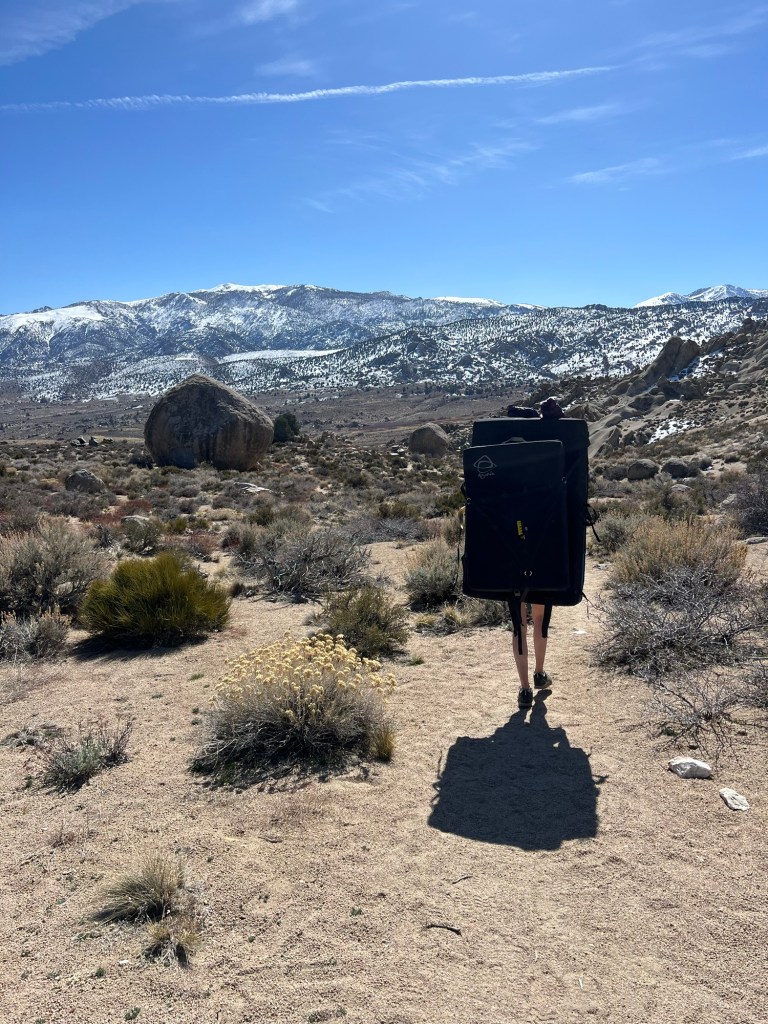
We’re in the Pollen Grains now, a secluded bouldering haven tucked behind a forty five minute hike from an already secluded bouldering haven called the Buttermilks in Bishop, California. To enter we passed through a tight trail system marked by thousands of small, quartzy rocks leading us from one massive bulging, chalky, forty foot tall rock to another. Avery pointed out different bouldering problems like they were celebrities spotted in the West Village. “That’s a super classic V13 over there. And around the corner here is another classic V4 that actually goes pretty high up, and has some challenging moves at the top. It’s pretty scary, I probably wouldn’t recommend it, but it was really cool.” I asked what make’s a problem a classic.“I think a combination of people talking, and maybe what the guide books say,” Avery replied. “A lot of the guide books have a star rating system.” Eventually we arrive at the Honey Boulder, home of Founder’s Fee – a V9 boulder problem that Avery has been projecting this year.
Avery flows through a memorized initial sequence of intricate crimps, high steps, and barn doors, then hops off the rock after trying to catch a right hand into a chalky lip that marks the midpoint of Founder’s Fee. “That was my high point! I’m freaking stoked. If I’m reaching my high point on my second go of the day then that’s a really good sign.” I asked Avery how this problem hooked her into a multi month project.“I was here earlier in the winter with a friend and did this adjacent problem, Cindy Swank, V7, very good, super fun. When I finished I saw this V9 was next to it, I wasn’t quite ready but then the next time I visited I got on it and felt good on the first few moves. It felt doable. Similarly fun but more challenging. I couldn’t wait to come back.”
Some boulders around here in Buttermilk County are immensely smooth, besides the chalky holds that seem like someone appended them onto the surface like a challenging ladder to climb up. Honey Boulder though, and many of the other Pollen Grain rocks, instead has a series of eroded canals that make a web throughout the face. For the most part these narrow cracks are impossible to get your fingers or climbing shoes into, let alone hold up your whole body. But in a few key areas, especially lower in the beginning of the problem, the erosions have carved away enough space to hold onto and are marked by decades of chalk stain. In between these key checkpoints are just those canals, offering the crux of the challenge. Be precise and strong enough to move through the web of narrow cracks to the next chiseled out respite, still extremely hard, back to the next narrow strain, eventually working your way up to the glassy top out. “I think its called the Pollen Grains because some of the rocks, from far away, look like little grains of pollen. Or maybe its because of all the bees,” Avery ponders. Climbing guidebooks rarely give an etymology for the names of areas, boulders, or problems, but they do tend to stick. “Sex Porpoise” and “Better Than Sex Porpoise” (allegedly, less fun than “Sex Porpoise”), both in Mickey’s Beach just outside of Marin County are good examples.
“I definitely need to pace myself, on the climbing.” Avery says. The second try of the day reigns as the furthest point she’s reached in the problem. She takes calculated, but not quite exact, breaks in between efforts trying to hone in on the right balance of staying in a flow state, not over tiring, while also getting a fresh perspective on how to stick this finicky next move. The hardest part is staying off the wall, not just jumping right back on after each try. I ask how she’s feeling. “I’m feeling good,” Avery responds, looking up at the problem. “I think long rests between attempts is a good idea…..It’s pretty hard to just sit here though,” looking up again. Thirty seconds later she gets up and gives it another go, again matching her high point, cruising, powerfully, through the initial sequence. “Ok, another rest.”
After each effort, especially ones that tap out at the crux she’s stuck on, Avery excitedly starts talking about the problem, both the pragmatics of trying to send it and the meta thoughts around how its existence. “I think for these little cracks it means you have to go more statically into that hold, you have to be more precise. And tense, I have to be so tense. It’s always three limbs on. I have to move statically.” For one of the toughest moves, immediately preceding the crux high right hand crimp, Avery has to kick out her left foot onto a tiny, though well placed jutting out knob of rock, then take her right foot off the wall and slowly traverse and shift her body across the face. Calling this move “static” reflects the difficulty here. “I’ve a friend who is five feet tall that does this move, and her body is completely sideways, its super cool.”
After a little under two hours of attempts, the sun starts catching the face of the problem and Avery suggests we hike up the nearby hill while we wait for some shade to return. As much as preparing your fingers and body for a session is essential to completing your project, timing the conditions of the rock has an equal part to play. Sunshine is pleasant, warm, and comfortable, but brings out more moisture on the rock and sweat on our hands. Harsher, dryer, and colder conditions make for the best attempts. Hiking up the nearby rocky hills, we wonder whether the Honey Boulder some geological eons ago tumbled down from this larger collection and wound up situated down below.
From up high in this new rocky universe the Honey Boulder looked more like a Honey Pebble. Founder’s Fee was a tiny aspect on one of many arbitrary rocks strewn about the surface. We had climbed and scrambled hundreds of feet, now with a full panoramic view of the surrounding Sierras – royal and impossible to capture on camera. At the peak of our forty minute scramble, Avery stared at a fantastical high ball boulder that towered over us. “I think this is a V14 that someone sent recently, I had no idea it was all the way up here.” We were staring at a flat wall, that only a superhero could possibly, maybe climb. Through a small crack to our left though, we could make out in the far distance the vibrant crash pads below the Honey Boulder and chalky dots mapping Founder’s Fee. With new perspective, we descended back down to the project at hand.
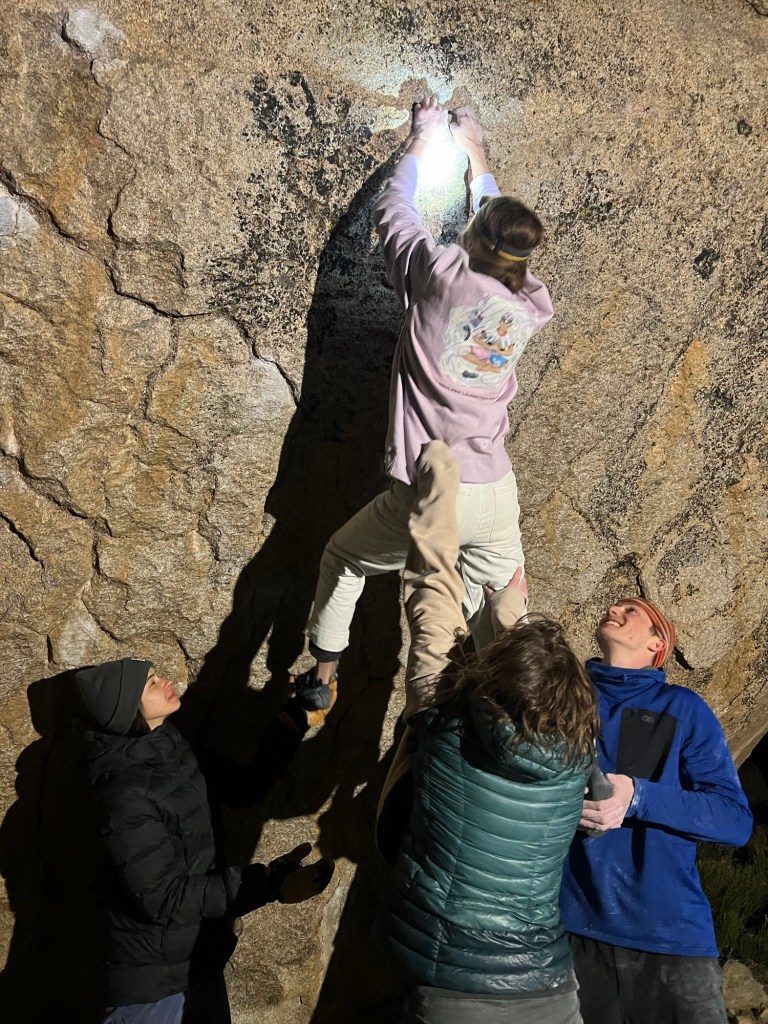
A few hours later, a few more friends arrived at the site and a rosy sky settled above the distant peaks. Avery unfurled a tripod light and faced it towards Founder’s Fee; the night session, cold and dry, was upon us. Laughter was everywhere, as was ironic jeering and honest positive encouragement. “All the tension in the world!”, Nick mimicked a Coloradan; he heard one shout this while his close friend was inches from completing a project (said friend subsequently fell all the way back to the pads from a fit of laugher). Avery was still stuck on the same impressive and challenging move with her right hand. As a moonless night fell, a short break to stare at the stars with the tripod light off turned into a long gaze deep into the constellations. “Ultimately bouldering is just a big hang,” Avery told me on our initial hike into the area. A few fits of laughter and UFO spottings later, while the five of us were lying down underneath this classic boulder problem, a shooting star zipped across the sky.



 Shaking the Snowglobe
Leave a comment